![Crosschq Logo 534x115.png]](https://support.crosschq.com/hs-fs/hubfs/Crosschq%20Logo%20534x115.png?height=40&name=Crosschq%20Logo%20534x115.png)
How Crosschq Interview uses AI to surface insights, detect risk signals, and help your team make faster, more consistent hiring decisions.
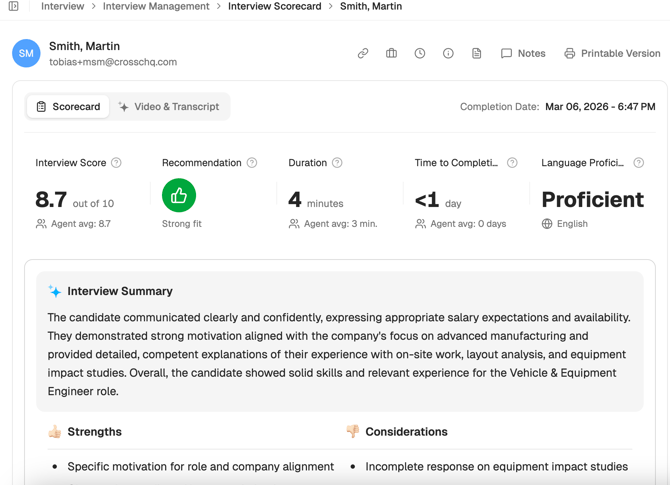 The Interview Report for Smith, Martin: overview strip showing Interview Score (8.7/10), Recommendation (Strong fit), Duration, Time to Completion, and Language Proficiency. The AI-generated Interview Summary appears below.
Overview
Interview Intelligence is the collection of AI-powered capabilities that run alongside every interview in Crosschq Interview. After an interview is complete, these features appear in the Interview Report and give recruiters, hiring managers, and their teams a richer picture of a candidate beyond what any single scorecard can show.
Interview Intelligence has three main components:
- AI Suggestions — Automatically generated insights for each competency, grounded in the candidate's interview responses.
- Fraud Analysis — A risk score that flags signals of candidate impersonation or other integrity concerns.
- Consensus — A combined view of every interviewer's scores and recommendations when more than one person rates the same candidate.
Which of these appear for a given interview depends on how your organization has configured Crosschq Interview. See Reading the Interview Report for a full walkthrough of the report layout.
AI Suggestions
AI Suggestions appear in the Scorecard tab of the Interview Report. An AI-generated Interview Summary appears at the top of the scorecard, followed by inline insights for each competency. They are generated by analyzing the candidate's responses and produce a short summary of what the candidate demonstrated, and where gaps may exist.
What AI Suggestions show
The Interview Summary and inline competency suggestions describe:
- The key points from the candidate's answers that are relevant to each competency.
- Strengths or evidence that supports a higher rating.
- Gaps or areas where the candidate's response was limited or unclear.
AI Suggestions are meant to help interviewers write their own notes and calibrate their ratings — they are a starting point, not a final verdict.
Fraud Analysis
Fraud Analysis runs automatically on AI Agent interviews and scores the session against a set of risk signals — patterns that may indicate the person who completed the interview was not the candidate, or that outside assistance was used. The results appear on the Fraud Analysis tab of the Interview Report.
Fraud Analysis is a tool to prompt further review, not an automated disqualification system. See Fraud Analysis in Crosschq Interview for a full explanation of the risk score and signal groups.
Consensus
When more than one interviewer has scored the same candidate, the Consensus tab brings all of their ratings together in one view. This makes it easier to spot disagreements, identify patterns, and arrive at a shared hiring recommendation.
Alerts
At the top of every Interview Report, an alerts card surfaces anything that needs your attention before you review the scores — such as a missing scorecard from an assigned interviewer, or a fraud signal above a configured threshold. The card is hidden automatically when there are no alerts.
Feature availability at a glance
| Feature | Interview type | Requires org setting |
|---|---|---|
| AI Suggestions | AI Agent interviews | Yes — AI features must be enabled |
| Fraud Analysis | AI Agent interviews | Yes — fraud detection must be enabled org-wide and per interview |
| Consensus tab | Scheduled interviews with 2+ interviewers | Yes — interview consolidation must be enabled |
| Consensus confirm/reject | Scheduled interviews | Yes — consolidation confirmation must be enabled |
| Alerts card | All interview types | No — shown whenever alerts are present |
If a feature listed above is missing from your report, contact your Crosschq administrator or reach out to Crosschq Support.