![Crosschq Logo 534x115.png]](https://support.crosschq.com/hs-fs/hubfs/Crosschq%20Logo%20534x115.png?height=40&name=Crosschq%20Logo%20534x115.png)
- What delivery guidance does
- Two different boxes
- The format
- How to add delivery guidance to a question
- Four rules
- Examples you can adapt
- When to leave it blank
- Before you save
- Delivery Guidance vs. Conditional Questions
What delivery guidance does
Delivery guidance tells the AI interviewer when an answer is not good enough yet, so it asks a follow-up instead of moving on. It is the difference between an interview that accepts "I've always wanted to work here" and one that asks what specifically drew the candidate in.
Two different boxes
When building an interview guide, make sure you are writing in the right field:
Scoring criteria — anything shaped like "Pass if the candidate confirms…" or "Evaluate this answer on whether…" — belong in Summarization Guidance. In the delivery guidance field they have no effect on scoring, and they can end up being read out loud to the candidate.
The format
Write delivery guidance as a test the answer has to pass, then say what to do when it does not:
Incomplete unless the answer names X. If that is missing, follow up once, then continue.
Fill in X with what the answer must contain. That is it.
How to add delivery guidance to a question
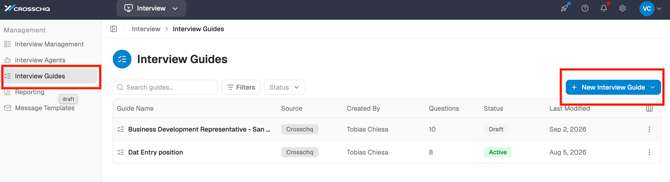
- Navigate to Interview Guides and click New Interview Guide, or open an existing guide to edit it.
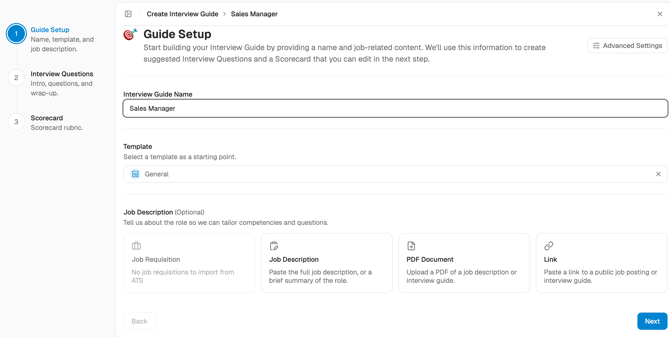
- On the Guide Setup screen, enter an Interview Guide Name and select a Template. Optionally, add a job description to help Crosschq suggest relevant questions. Click Next.
- On the Interview Questions screen, click the Question Config icon (the sliders icon) on the question you want to configure.

- In the panel that opens, click the Delivery guidance field and enter your guidance following the format and rules below.
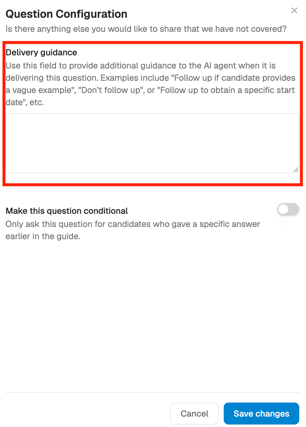
- Click Save changes.
Four rules
1. Start with a condition, never with a verb
Write "Incomplete unless the answer names…", not "Ask what they did". A verb has nothing to wait for, so the interviewer acts on it immediately — reading it out loud and spending its one follow-up before the candidate has said anything.
2. Say what the answer must contain, not what it must not be
"Incomplete unless the answer names X" holds up. "Incomplete if it only says Y" is defeated the moment the candidate adds any filler — the condition stops matching and the follow-up never fires.
3. Describe what is missing, never the words to say
Anything phrased as a sayable sentence will get said, and example questions in quotation marks get delivered to the candidate word for word. Define the bar and let the interviewer find its own wording.
4. One follow-up, with an explicit exit
Open-ended retries never end. Always say what happens after the follow-up.
Examples you can adapt
Experience overview — "Tell me about yourself and walk me through your experience."
Incomplete unless the answer names where they worked or studied, what they did there, and roughly when. If any of those three is missing, follow up once for the missing one, then continue.
Behavioral / situational — "Describe a time when you…"
Incomplete unless the answer names a specific situation, what they personally did, and what happened as a result. If any of those three is missing, follow up once for the missing one, then continue.
Tools and systems — "Tell me about your experience with…"
Incomplete unless the answer says what they personally did with the tool. Naming the tool on its own does not count. If that is missing, follow up once, then continue.
Motivation — "Why did you apply to this company?"
Incomplete unless the answer names one specific thing about this role, team or company and ties it to something in their own background. Liking or admiration on its own does not count. If that tie is missing, follow up once, then continue.
Career goals — "Where do you see yourself in three years?"
Incomplete unless the answer names a concrete capability or responsibility they want to have by then. A title or a seniority level on its own does not count. If that is missing, follow up once, then continue.
Results and impact — "What was the outcome?"
Incomplete unless the answer says how they knew it worked. A general claim of success does not count. If that is missing, follow up once, then continue.
Specific dates — "When could you start?"
Incomplete unless the answer gives a specific day, month and year. A range, a month on its own, or "as soon as possible" does not count. If that is missing, follow up once, then continue.
Yes/no screening question — "Are you authorized to work in the United States?"
Do not follow up.
Sensitive question you do not want pressed — "Does the salary meet your expectations?"
Whatever reason they give is enough. Do not negotiate it and do not put this question a second time.
When to leave it blank
Most questions do not need delivery guidance. Leave it empty when the question is self-contained and any reasonable answer is acceptable — blank means the interviewer uses its normal judgment, which is usually right.
Use delivery guidance for questions where a vague answer would waste the interview: open-ended experience questions, motivation questions, and anything where you need a specific fact.
Before you save
- Does it start with a condition, not a verb?
- Does it say what the answer must contain, rather than what it must not be?
- Are there any quotation marks? Remove them — quoted text gets spoken.
- Does it say what to do after the follow-up?
- Is this actually scoring criteria? If so, move it to Summarization Guidance.
Delivery Guidance vs. Conditional Questions
Both features let you shape how the interview unfolds, but they work at different levels.
Use Delivery Guidance when you want the AI to push for more detail if the candidate is vague — for example, if their motivation answer does not name anything specific about the role or company.
Use Conditional Questions when the answer to one question changes what you need to ask next — for example, if a candidate says they are not based in Chicago, you want to follow up on relocation, but candidates who are already there should skip that question entirely.
Example — using both together:
Question 1: "This role is based in Chicago with no relocation assistance. Can you confirm you're applying for this location?" (Yes/No)
→ If No: a Conditional Question appears: "Would you be able to self-relocate?" — with Delivery Guidance set to "Incomplete unless the answer confirms whether they can self-relocate and by when. If that is missing, follow up once, then continue."
→ If Yes: the guide continues to the next question.